Asphalt Shingles in Greater Boston, MA
Expert Asphalt Shingles in Greater Boston, MA — Storm-Tested, Warranty-Backed
Blue Hills Roofing Solutions delivers expert roofing solutions for Greater Boston, MA homes and businesses. As a locally owned, licensed team, we stand behind every project with quality materials and lasting workmanship.
Asphalt shingles are the most widely installed residential roofing material in North America, and for good reason — they deliver an exceptional balance of affordability, durability, and curb appeal that suits Greater Boston’s demanding four-season climate. Whether you own a Victorian triple-decker in Somerville, a Colonial in Milton, or a mid-century Cape Cod in Weymouth, asphalt shingles can be engineered to withstand the region’s heavy snow loads, nor’easter wind gusts, and freeze-thaw cycles that routinely challenge roofs every winter.
At Blue Hills Roofing Solutions, we specialize in asphalt shingle installation, repair, replacement, and maintenance across the Greater Boston area. Our team understands the unique architectural heritage and weather patterns of eastern Massachusetts, from the salt-air exposure along the South Shore to the urban heat island effects concentrated in Boston proper. Call us today at (617) 712-2287 to speak with a local roofing expert.
Understanding Asphalt Shingles
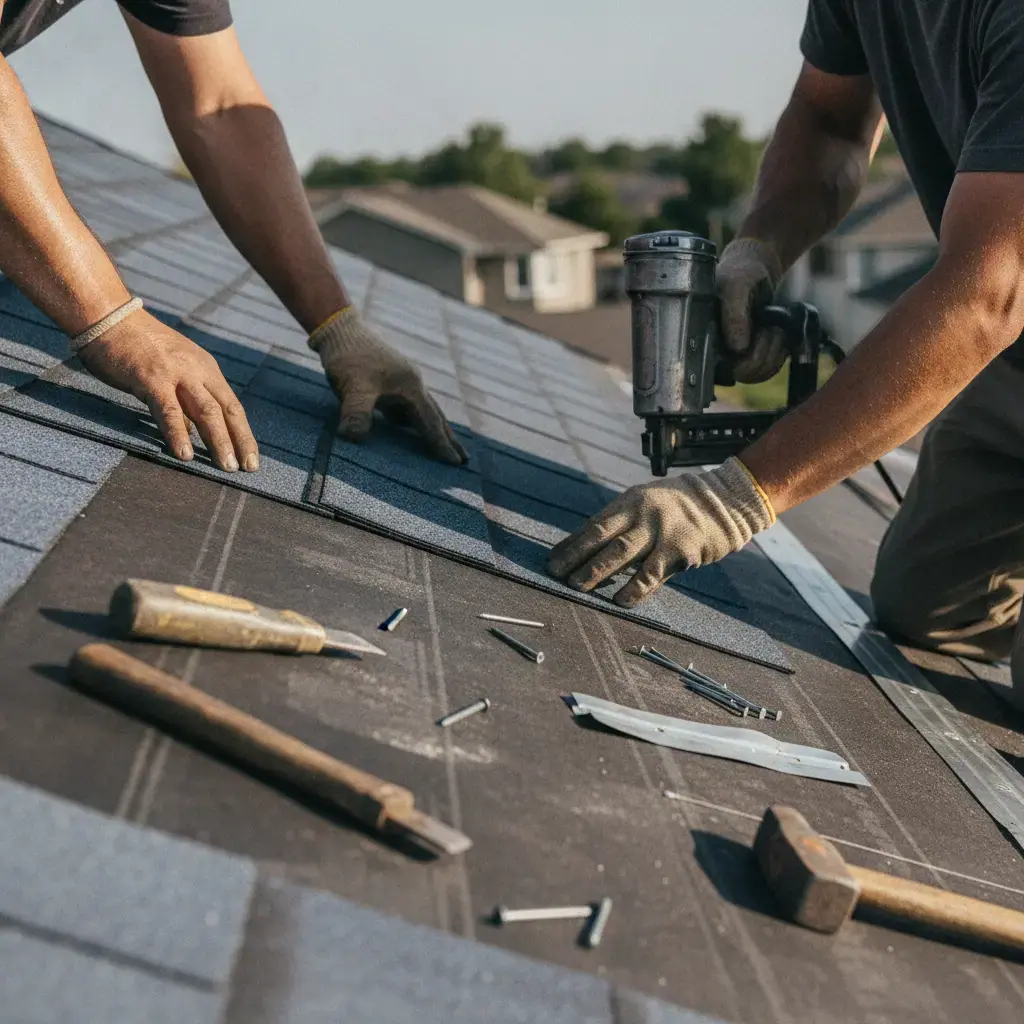
Asphalt shingles are composite roofing panels composed of a fiberglass or organic mat base saturated with asphalt and coated with ceramic-mineral granules on the exposed surface. Those granules serve a dual purpose: they reflect ultraviolet radiation to slow asphalt degradation and provide the textured color finish that gives your roof its visual character. The underside is coated with a self-sealing adhesive strip that bonds adjacent shingles together under heat, creating a wind-resistant surface.
Modern asphalt shingles fall into two primary categories. Three-tab shingles are the traditional, single-layer product featuring three uniform cutouts along the bottom edge. They weigh roughly 200–250 lbs per roofing square (100 sq ft) and carry wind ratings up to 60 mph — adequate for mild climates but increasingly undersized for coastal New England. Architectural (laminated) shingles, also called dimensional shingles, bond two layers of asphalt together in irregular patterns that mimic the shadow lines of wood shake or slate. They weigh 300–400 lbs per square, resist winds up to 130 mph in premium grades, and carry manufacturer warranties of 30 to lifetime coverage — a meaningful advantage for Greater Boston homeowners navigating winter nor’easters.
Read moreShow less
Historically, asphalt shingles rose to dominance in the United States during the 1920s as manufactured alternatives to costly slate and wood shake. In Greater Boston, the post-WWII housing boom of the late 1940s and 1950s brought asphalt shingles to thousands of new ranch-style homes in suburbs like Braintree, Randolph, and Dedham. By the 1970s, they had replaced aging slate roofs on many of the region’s older Victorian and Federal-style homes as the original slate became cost-prohibitive to repair.
Today, asphalt shingles cover an estimated 75–80% of residential rooftops throughout eastern Massachusetts. In dense urban neighborhoods like Dorchester, Jamaica Plain, and Allston, they top thousands of triple-deckers and two-family structures built between 1880 and 1930. In the inner suburbs of Newton, Brookline, and Needham, they frequently appear alongside original slate on large Colonial Revivals and Tudor-style homes dating from the 1910s–1940s. Understanding which shingle grade, color, and underlayment system is right for your specific building type and neighborhood is exactly where Blue Hills Roofing Solutions brings value.
Learn more about our full Roof Installation services
Why Asphalt Shingles Are Needed in Greater Boston, MA
Extreme Freeze-Thaw Cycling
Greater Boston averages 35–40 freeze-thaw cycles per winter, according to NOAA climate data for Logan International Airport. Each cycle forces meltwater into microscopic cracks between shingle granules, which then expands as it refreezes, accelerating granule loss and exposing the underlying asphalt mat. Architectural shingles rated for Class 4 impact resistance and rated down to -40°F flexibility are specifically engineered to survive this cyclical stress — making proper shingle selection critical in Massachusetts.
Snow Load and Ice Dams
The Greater Boston area receives an average of 43.8 inches of snowfall per year, with major storm events significantly exceeding that figure. The February 2015 nor’easter cluster deposited over 110 inches of snow across the region in roughly six weeks, collapsing roofs in Quincy and Malden and creating catastrophic ice dams from Waltham to Weymouth. Ice dams form when heat escaping through an under-insulated attic melts snowpack on the roof deck; meltwater runs to the cold eave edge, refreezes, and backs up under the bottom course of shingles. Without a properly installed ice-and-water shield membrane extending at least 24 inches inside the interior wall line — as required by the Massachusetts State Building Code (780 CMR) — water infiltration can cause tens of thousands of dollars in interior damage. Architectural shingles installed over a continuous self-adhering underlayment system are the standard of care for Greater Boston homes.
Nor’easter Wind Uplift
The National Weather Service categorized the March 2018 nor’easter series — four storms in eleven days — as producing sustained winds of 45–60 mph with gusts reaching 76 mph at Blue Hill Observatory in Milton (elevation 635 ft), the longest-running weather station in the United States. Three-tab shingles with 60-mph wind ratings routinely failed across exposed ridge lines in Canton, Norwood, and Dedham during these events. Architectural shingles with 130-mph wind certifications, properly nailed with six fasteners per shingle rather than the standard four, provide the uplift resistance needed for exposed Greater Boston locations.
Salt Air and Coastal Humidity
Communities along Massachusetts Bay — including Quincy, Weymouth, and Lynn — experience elevated salt-air exposure that accelerates granule erosion and algae growth on south- and west-facing roof planes. Algae streaking (caused by Gloeocapsa magma) is particularly prevalent on shaded north-facing slopes in wooded suburbs like Milton and Canton. Shingles treated with copper-infused granules, such as those in the Owens Corning Duration Storm or CertainTeed Landmark IR series, actively inhibit algae growth and are recommended for properties within 5 miles of tidal water.
Urban Heat Island Effect
Dense urban neighborhoods in Boston, Somerville, Medford, and Malden experience summer surface temperatures 4–7°F higher than surrounding suburbs due to the urban heat island effect. This thermal loading accelerates asphalt oxidation and shortens shingle lifespan. Cool-roof shingles with solar-reflective granules — rated by the Cool Roof Rating Council (CRRC) — can reduce rooftop surface temperatures by up to 50°F and are increasingly specified for flat-to-low-slope attached structures in these dense urban zones.
Learn about our Roof Repair services for storm and ice dam damage
Free, no-obligation estimates
Talk to Blue Hills Roofing Solutions
Tell us what you need and we’ll take it from there.
Signs You Need Asphalt Shingle Repair or Replacement in Greater Boston
Age-Related Wear
- Shingles are 20+ years old (three-tab) or 25+ years old (architectural) — common for homes built during Randolph’s and Braintree’s 1970s–1980s suburban expansion.
- Widespread granule loss visible in gutters or on the ground; bare asphalt mat showing dark patches.
- Shingles curling upward at edges (cupping) or bowing downward in the center (clawing), indicating loss of flexibility from repeated thermal cycling.
Storm Damage Indicators
- Missing shingles or exposed roof deck after a nor’easter — immediate emergency service required.
- Impact craters or bruising from hail, visible as circular indentations with granule displacement (common after spring convective storms).
- Cracked or split shingles along ridge caps, particularly on south-facing slopes exposed to wind-driven sleet.
Interior Warning Signs
- Water stains on ceilings or attic sheathing, especially following snowmelt — a classic ice dam symptom in Greater Boston winters.
- Daylight visible through attic rafters.
- Mold or mildew odor in the attic space during humid summer months.
Moss and Algae Growth
- Black algae streaks on north-facing slopes in shaded yards — prevalent in Brookline, Newton, and wooded Milton neighborhoods.
- Thick moss growth lifting shingle edges, creating pathways for water infiltration.
Schedule a professional Roof Inspection to assess your shingle condition
Our process
Our Asphalt Shingle Installation and Replacement Process
Blue Hills Roofing Solutions follows a structured, code-compliant process for every asphalt shingle project in Greater Boston — from a single-slope repair in Watertown to a full replacement on a large Colonial in Wellesley.
- 01
Free Roof Assessment (1–2 Hours)
A certified Blue Hills estimator inspects your roof deck, attic ventilation, flashing condition, and current shingle system. We use drone imaging for steeply pitched roofs common to Victorian-era homes in Somerville and Jamaica Plain, where ladder-only access
- 02
Material Selection and Permitting (3–7 Business Days)
We help you select the appropriate shingle grade, color, and manufacturer warranty tier. Greater Boston municipalities including Boston, Brookline, and Newton require building permits for full roof replacements; we pull all required permits so you remain fully
- 03
Tear-Off and Deck Inspection (Day 1)
We remove existing shingle layers — Massachusetts code limits most residential roofs to two layers before a full tear-off is mandatory. All debris is loaded into on-site dumpsters and hauled away the same day. We inspect the exposed deck for rot, delamination,
- 04
Underlayment and Ice-and-Water Shield Installation (Day 1–2)
Per 780 CMR (Massachusetts State Building Code), we install self-adhering ice-and-water shield at all eaves, valleys, and penetrations. In Greater Boston, we extend eave protection a minimum of 36 inches past the interior wall line — exceeding the 24-inch mini
- 05
Shingle Installation (Day 1–3 Depending on Roof Size)
Shingles are installed starting at the eave and working upward in proper offset courses. We use a six-nail fastening pattern for wind uplift performance in coastal and exposed locations (Quincy, Weymouth, Lynn). All ridge caps are hand-cut architectural shingl
- 06
Flashing and Ventilation (Day 2–3)
All step flashing, counter flashing, valley flashing, and pipe boot seals are replaced with new galvanized or lead-coated copper components. Attic ventilation is balanced to meet the 1:150 net free area ratio, critical for preventing the moisture accumulation
- 07
Final Inspection and Cleanup (Final Day)
We perform a point-by-point quality inspection and use a magnetic roller to collect stray nails from your yard. A third-party municipal inspection is scheduled where required. You receive your warranty documentation, permit closeout, and a photo report of the
Asphalt Shingle Methods and Approaches We Use
Full Tear-Off and Replacement
The most comprehensive approach, removing all existing layers down to the roof deck. Required when two shingle layers already exist, when deck damage is present, or when the home is in a Greater Boston historic district requiring a uniform new surface. This method is standard for post-storm replacements following major nor’easters and for homes in Quincy and Weymouth showing extensive ice dam damage.
Overlay (Re-Roof)
A second layer of architectural shingles is installed directly over a single existing layer in sound condition. This approach saves 15–20% in labor costs and is appropriate for mid-century ranch homes in Randolph, Canton, and Norwood where the deck is structurally sound and only one layer exists. Note: Massachusetts code prohibits overlay on roofs with existing overlay layers, and many homeowner insurance policies require full tear-off for warranty purposes.
Partial Repair and Spot Replacement
Individual damaged shingles or sections are replaced without disturbing the surrounding roof. This is cost-effective for isolated storm damage — a single missing shingle section after a wind event — and is commonly used for our emergency roofing response calls across Boston, Medford, and Malden. Color-matching to existing shingles is performed to minimize visual impact, though some weathering differential is expected with aged systems.
Hip-and-Ridge Cap Replacement
Ridge caps and hip caps are the most wind-exposed shingle elements and frequently fail before the field shingles. Isolated ridge cap replacement using architectural ridge shingles — rather than thin three-tab cut-downs — significantly extends overall roof performance. This targeted method is popular for Somerville and Medford triple-deckers where budget is a primary concern.
Class 4 Impact-Resistant Shingle Upgrades
For homeowners in hail-prone corridors or those seeking maximum insurance premium discounts, we install UL 2218 Class 4 impact-rated shingles. Several Massachusetts home insurers offer 5–25% premium reductions for documented Class 4 installations — a meaningful long-term saving.
Asphalt Shingles Cost in Greater Boston, MA
Understanding the true cost of asphalt shingle installation or replacement in Greater Boston requires accounting for Massachusetts-specific labor rates, permit fees, and material considerations. The following ranges reflect 2024 market conditions in eastern Massachusetts.
Typical Price Ranges
- Three-tab shingle installation: $4.50–$6.50 per square foot installed, or $8,500–$14,000 for a typical 1,800–2,200 sq ft Greater Boston home.
- Architectural (dimensional) shingle installation: $6.00–$9.00 per square foot installed, or $11,000–$20,000 for the same home size.
- Premium architectural / designer shingle installation: $9.00–$13.00 per square foot, or $16,000–$28,000, common for large Colonials in Newton, Wellesley, and Needham.
- Partial repair (spot replacement): $350–$1,500 depending on extent of damage.
Read moreShow less
Key Cost Factors in Greater Boston
- Roof pitch: Steeply pitched Victorian and Colonial roofs common in Brookline and Newton add 15–25% to labor costs due to safety equipment requirements.
- Building permit fees: Range from $150–$600 depending on municipality; Boston, Brookline, and Newton are among the higher-fee jurisdictions.
- Deck repair: Sheathing replacement runs $3.00–$5.00 per square foot; extensive damage from ice dams can add $1,500–$6,000 to a project.
- Ice-and-water shield: Extended coverage beyond code minimum adds $0.75–$1.25 per square foot — strongly recommended throughout Greater Boston.
- Dumpster and disposal: $400–$700 per project; urban neighborhoods with limited street access (dense Boston neighborhoods, Somerville) may add permitting costs for dumpster placement.
- Contractor overhead: Greater Boston labor rates run 20–30% above national averages due to the local cost of living.
We provide detailed, line-item written estimates at no charge. Financing options are available for qualifying homeowners. Call (617) 712-2287 to schedule your free estimate.
Explore Roof Maintenance plans to protect your shingle investment
Neighborhoods and Communities We Serve Across Greater Boston
Milton, MA — Blue Hill Estates and Central Milton
Milton’s housing stock is dominated by large Colonial Revivals and Tudor-style homes built between 1910 and 1950. Proximity to Blue Hill Observatory means these properties face some of the highest wind-exposure risks in eastern Massachusetts. We frequently specify premium 130-mph architectural shingles with six-nail fastening patterns for Milton ridge lines.
Somerville, MA — Winter Hill and Prospect Hill
Somerville’s triple-decker stock, built predominantly 1890–1930, presents low-to-moderate pitch roofs with aging flat or shed dormers. These roofs suffer disproportionate ice dam damage due to poor historic attic insulation. Our Somerville projects frequently combine architectural shingle replacement with attic air-sealing upgrades to address the root cause.
Newton, MA — Chestnut Hill and Newton Centre
Newton’s Chestnut Hill and Newton Centre neighborhoods feature large, complex rooflines on homes valued at $1.5M–$3M+. Homeowners here frequently specify designer-grade architectural shingles in slate or wood-shake profiles to maintain historic character. Our team has experience coordinating with Newton’s Historic District Commission for eligible properties.
Quincy, MA — Wollaston and Germantown
Quincy’s coastal proximity — particularly in Wollaston near Quincy Bay — creates elevated salt-air and wind exposure. We recommend algae-resistant, copper-granule shingles for all Quincy properties within one mile of the waterfront, paired with stainless-steel fasteners to resist coastal corrosion.
We also serve Boston, Braintree, Randolph, Dedham, Canton, Brookline, Weymouth, Needham, Norwood, Medford, Waltham, Wellesley, Watertown, Malden, Lynn, and surrounding communities. View our complete Greater Boston Service Area map
Asphalt Shingle Maintenance Tips for Greater Boston Homeowners
Proactive maintenance can extend asphalt shingle lifespan by 5–10 years, even in Greater Boston’s demanding climate. Follow these location-specific best practices:
- Schedule annual inspections in October: Have a professional inspect your roof before the first nor’easter season. Early detection of loose shingles or failing caulk prevents major water infiltration during February snowmelt.
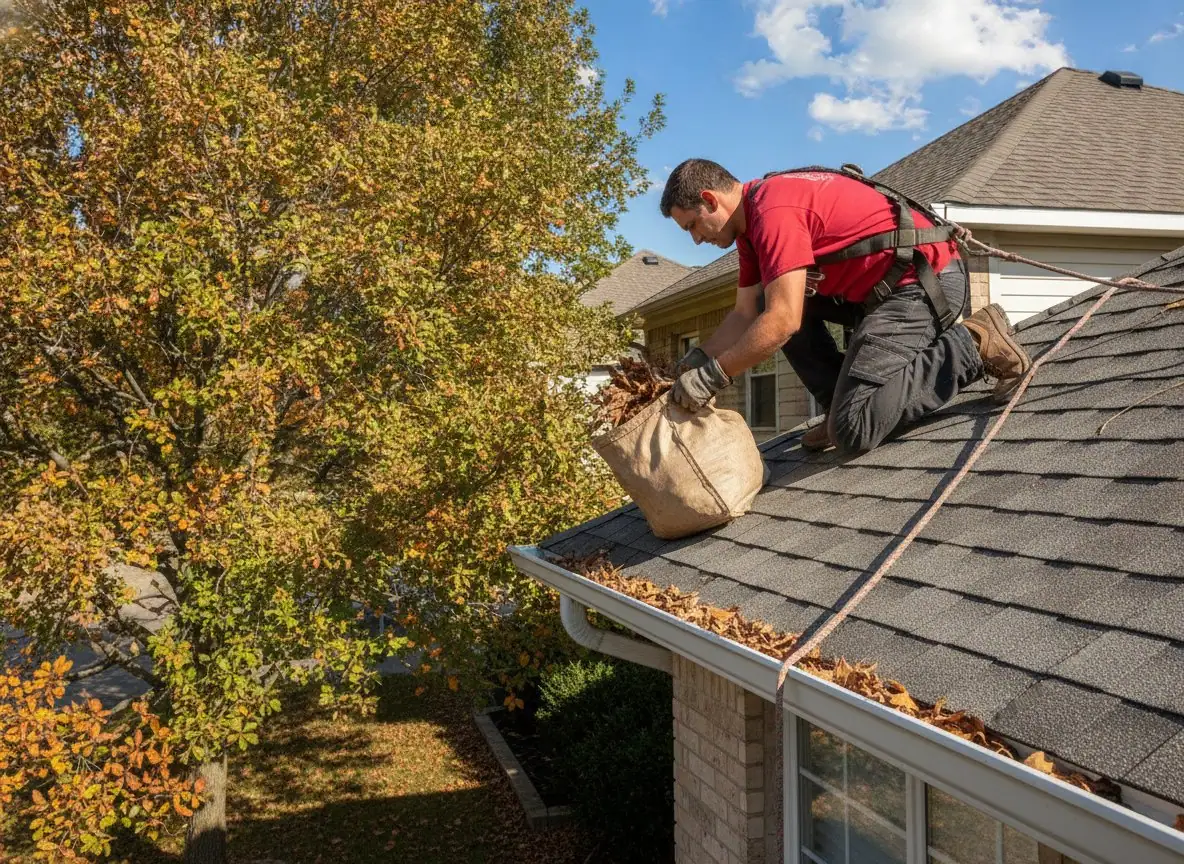
- Clean gutters twice yearly: Spring maple seed and autumn leaf debris clog gutters, backing water up to eave edges and dramatically increasing ice dam risk in Greater Boston winters. Clean in early November and again in April.
- Treat algae within one season of first appearance: Apply a zinc-sulfate or copper-sulfate roof wash to halt Gloeocapsa magma growth, particularly on north-facing slopes shaded by mature oaks common throughout Milton, Canton, and Needham.
- Trim overhanging branches: New England’s mature tree canopy — including oak, maple, and white pine — deposits debris and retains moisture on shingles. Keep branches at least 10 feet from the roof surface.
- Install attic insulation and air sealing: The single most effective ice dam prevention strategy. Target R-49 attic insulation per Massachusetts Energy Code for homes built before 2000.
- Never use a metal shovel on shingles: After heavy snowfall, use a plastic roof rake from ground level; metal contact damages shingle granules and voids many manufacturer warranties.
- Inspect flashing annually: Chimney, dormer, and skylight flashing failures are the leading source of Greater Boston roof leaks. Check for lifted counter flashing and cracked sealant every fall.
Why Choose Blue Hills Roofing Solutions for Asphalt Shingles in Greater Boston
Blue Hills Roofing Solutions is a locally rooted Greater Boston roofing contractor with deep knowledge of the building types, weather patterns, municipal codes, and neighborhood-specific challenges that define roofing work in eastern Massachusetts. We are not a national franchise — we are your neighbors, operating across the same communities where our crews live and whose homes we protect every season.
Our teams are trained in Massachusetts State Building Code (780 CMR) requirements specific to roofing, and we stay current with evolving energy code provisions affecting attic insulation and ventilation. We pull all required permits, coordinate HDC reviews where needed, and ensure every project passes municipal inspection.
Read moreShow less
We offer emergency roofing response 24 hours a day during major storm events — because a February nor’easter doesn’t respect business hours. Our commitment is to respond within 4 hours for emergency tarping calls throughout our Greater Boston service territory.
Learn about our 24/7 Emergency Roofing services Explore our Commercial Roofing capabilities
FAQ
Frequently Asked Questions About Asphalt Shingles in Greater Boston, MA
How long do asphalt shingles last in the Greater Boston climate?
In Greater Boston’s climate, three-tab shingles typically last 15–20 years due to the region’s aggressive freeze-thaw cycling and nor’easter exposure. Architectural shingles perform significantly better, averaging 25–35 years when properly installed with ice-and-water shield and adequate attic ventilation. Premium designer shingles can reach 40–50 years. The February 2015 blizzard cluster significantly shortened the useful life of shingles installed in the 1990s throughout the south suburbs, accelerating replacement timelines for many Quincy, Braintree, and Weymouth homeowners.
How much does asphalt shingle replacement cost near me in Greater Boston?
For a typical 1,800–2,200 sq ft Greater Boston home, expect to pay $11,000–$20,000 for a full architectural shingle tear-off and replacement, including permits, ice-and-water shield, and disposal. Pricing varies significantly by municipality (Boston and Brookline permit fees are higher), roof pitch (steep Victorians cost more to work on), and deck condition. We provide free, no-obligation written estimates for all Greater Boston locations.
Do I need a building permit for asphalt shingle replacement in Boston or Newton?
Yes. The City of Boston, City of Newton, Town of Brookline, and most Greater Boston municipalities require a building permit for full roof replacements. Blue Hills Roofing Solutions handles all permit applications on your behalf and schedules the required municipal inspection upon project completion. Failure to permit a roof replacement can complicate homeowner insurance claims and property sales.
What is an ice dam and how do asphalt shingles help prevent it?
An ice dam forms when heat escaping through a poorly insulated attic melts snow on the upper roof, which then refreezes at the cold eave edge. The resulting ice ridge traps meltwater, which backs up under shingle courses and enters the structure. Properly installed self-adhering ice-and-water shield membrane beneath the shingles at all eaves, valleys, and penetrations — as required by Massachusetts Building Code — prevents this water from reaching the roof deck. Greater Boston experienced widespread ice dam damage across Malden, Waltham, and Medford during the historic 2015 winter, making this a critical local concern.
Can I install asphalt shingles over my existing roof in Massachusetts?
Massachusetts building code allows a maximum of two shingle layers on a residential roof. If your home already has two layers, a full tear-off to the deck is required before new shingles can be installed. Many Greater Boston homes built in the 1960s–1980s already received one overlay during the 1990s or 2000s, making a full tear-off the most likely requirement. We assess this as part of every free inspection.
How long does asphalt shingle installation take for a typical Greater Boston home?
Most standard residential replacements — 1,500–2,500 sq ft — are completed in 1–3 days of field work. Larger or more complex rooflines (multiple dormers, slate transitions, steep pitches common in Brookline and Newton) may require 3–5 days. Permit processing adds 3–7 business days before work can begin in permitting jurisdictions. We schedule projects to avoid the core of nor’easter season when possible, while maintaining emergency responsiveness year-round.
Are asphalt shingles a good choice for triple-deckers and multi-family homes in Boston?
Absolutely. Architectural asphalt shingles are the dominant roofing choice for Greater Boston’s tens of thousands of triple-deckers and two-family structures. Their low installed cost relative to metal or tile roofing, combined with 30-year warranties now common in premium grades, makes them highly cost-effective for investment properties. We work regularly with landlords and property managers across Dorchester, East Boston, Roxbury, and Somerville to maintain multi-family roofs on a scheduled basis. Explore our Roof Maintenance programs for multi-family properties
Do you offer emergency asphalt shingle repairs after storms in Greater Boston?
Yes. Blue Hills Roofing Solutions provides 24/7 emergency roofing response throughout our Greater Boston service territory. After a nor’easter or severe thunderstorm causes sudden shingle loss or structural damage, call us at (617) 712-2287 and we will dispatch a crew for emergency tarping and assessment within 4 hours. Emergency shingle repair is available same-day for most locations including Boston, Quincy, Medford, Lynn, and all surrounding communities.
Get in touch
Find roofing help near you
Request a free estimate online or give us a call — our team will follow up quickly.
- Call us(617) 712-2287
- Visit2 Granite Ave Ste 512, Milton, MA 02186
- HoursMon-Sun 7am-7pm