Roof Replacement in Greater Boston, MA
Quality Roof Replacement in Greater Boston, MA — Built to Last
Need roof replacement in Greater Boston, MA? Blue Hills Roofing Solutions serves Boston, Quincy, Newton & 16+ communities. Call (617) 712-2287 for a free estimate.
Roof replacement is the complete removal of your existing roofing system down to the decking and the installation of an entirely new roof — including underlayment, flashing, shingles or membrane, and all associated components. Unlike a simple repair, full replacement addresses systemic deterioration, restores structural integrity, and dramatically extends the service life of your home or commercial building.
Greater Boston’s environment presents roofing challenges found almost nowhere else in the United States: brutal nor’easters that dump 20-plus inches of snow in a single event, freeze-thaw cycles that can repeat 40 or more times each winter, and Atlantic coastal humidity that accelerates organic material breakdown. Blue Hills Roofing Solutions was built around this specific climate. Our crews are trained on the codes, materials, and installation techniques that Boston-area homes demand, and we serve every community from Brookline to Lynn, Needham to Malden, with the expertise your roof deserves.
Call us today at (617) 712-2287 for a free roof replacement assessment.
Understanding Roof Replacement in Greater Boston
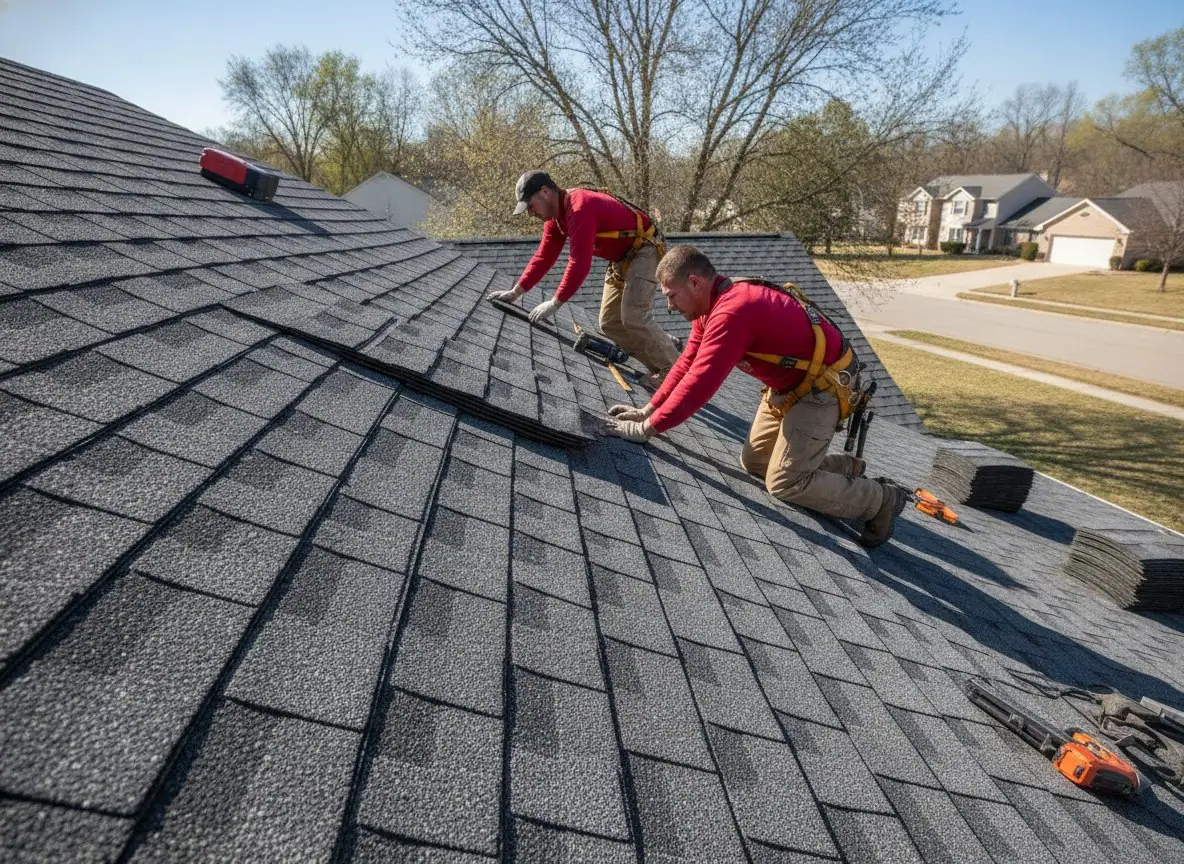
A roof replacement is not simply swapping old shingles for new ones. It is a full-system renewal: old materials are torn off, the decking is inspected and repaired where needed, new ice-and-water shield is installed at eaves and valleys, synthetic or felt underlayment goes down across the entire field, and then the finished roofing product — architectural asphalt shingles, standing-seam metal, slate, rubber (EPDM), or TPO membrane — is installed according to manufacturer specifications and Massachusetts State Building Code 780 CMR.
Historically, Greater Boston’s housing stock reflects centuries of construction trends. The triple-deckers that define Somerville, Malden, and parts of Medford were built primarily between 1880 and 1930 with low-slope roofs and limited attic ventilation — a design that is particularly vulnerable to ice dam formation. Colonial and Cape Cod homes throughout Newton, Needham, and Wellesley date to the 1940s through 1960s and are now reaching the end of their second or even third roofing life cycle. Victorian and Federal-style homes in Brookline, Milton, and parts of Boston’s older neighborhoods often feature ornate dormers, multiple roof planes, and slate or wood-shake originals that require specialized replacement expertise.
Read moreShow less
Asphalt shingles — the most common residential roofing product in Massachusetts — carry a rated lifespan of 25 to 50 years depending on grade, but Greater Boston’s climate consistently shortens that window. Independent roofing industry data suggests that standard three-tab shingles in coastal New England environments perform for 15 to 20 years before requiring replacement, while higher-grade architectural shingles average 22 to 30 years of effective service life. Flat and low-slope commercial roofing membranes typically require replacement every 15 to 25 years, depending on maintenance history and material type.
Understanding these timelines is critical for Greater Boston property owners. Replacing a roof on schedule — rather than waiting for active leaks — prevents tens of thousands of dollars in secondary damage to insulation, framing, drywall, and interior finishes. Schedule a professional roof inspection to determine where your roof falls in its service life cycle.
Why Roof Replacement Is Needed in Greater Boston, MA
Severe Winter Weather and Ice Dams
Greater Boston averages approximately 48 inches of snowfall per year, but individual storms can far exceed that benchmark. The blizzard of January 2015 deposited over 24 inches in Boston in a single event, and the winter of 2014–2015 as a whole produced a record-shattering 110.6 inches of snowfall. These loads place enormous stress on roof structures. More damaging, however, is the freeze-thaw cycle that follows each storm. Boston typically experiences 40 to 60 freeze-thaw cycles per winter season, meaning water enters microscopic cracks in shingles, freezes, expands, and mechanically pries those materials apart — accelerating deterioration by two to three times compared to inland New England climates.
Ice dams are a particularly destructive consequence of this cycle. When heat escapes through poorly insulated attics — common in the pre-1950 housing stock throughout East Boston, Dorchester, and Roxbury — it melts the base of snow on the roof. That meltwater runs down to the cold eaves and refreezes, forming an ice dam. Water then backs up behind the dam and infiltrates beneath shingles, destroying underlayment and soaking into the decking within days. Ice-dam damage is one of the leading causes of premature roof replacement across the region.
Atlantic Coastal Humidity and Salt Air
Communities along Boston Harbor — including Quincy, Weymouth, and the coastal neighborhoods of Lynn — experience sustained salt-laden moisture that degrades asphalt shingles’ granule adhesion and accelerates corrosion in metal flashing. Coastal properties commonly see 20 to 30 percent shorter roofing lifespans than inland properties. The combination of high humidity (Boston’s average relative humidity sits around 72 percent year-round) and temperature swings causes asphalt to expand and contract, leading to cracking and curling far earlier than manufacturers’ rated lifespans suggest.
Urban Heat Islands and Flat Roof Degradation
Dense urban neighborhoods such as Somerville’s Davis Square area, Malden Center, and downtown Watertown generate significant urban heat island effects, pushing summer roof-surface temperatures above 160°F on standard dark-colored asphalt shingles. This thermal stress causes granule loss, blistering, and membrane deterioration on flat commercial roofs. Many commercial buildings in the Waltham and Newton commercial corridors are overdue for flat-roof membrane replacement as a direct result of this compounded heat stress.
Wind Events and Nor’easters
Nor’easters frequently produce sustained winds of 45 to 60 mph across Greater Boston, with gusts exceeding 70 mph during major events like the March 2018 nor’easter series that caused widespread roof damage in Braintree, Randolph, and Canton. Even wind speeds of 40 mph can lift improperly sealed or aged shingles, exposing underlayment and decking to water infiltration within hours.
Aging Housing Stock
According to U.S. Census data, more than 60 percent of housing units in the City of Boston were built before 1940. Across the broader Greater Boston metro, the median housing age is among the oldest in the country. Roofs installed during postwar construction booms in Dedham, Norwood, and Canton are now 50 to 70 years old — well beyond any practical service life regardless of material type.
Free, no-obligation estimates
Talk to Blue Hills Roofing Solutions
Tell us what you need and we’ll take it from there.
Signs You Need Roof Replacement in Greater Boston
Visual Exterior Warning Signs
- Shingles are curling at the edges (cupping) or in the center (clawing)
- Widespread granule loss visible in gutters or at downspout discharge points
- Missing, cracked, or broken shingles across more than 20 percent of the roof surface
- Visible sagging or dipping in the roof deck, particularly along ridge lines or between rafters
- Dark streaking or moss/algae growth covering multiple roof planes
- Rust staining around flashing at chimneys, skylights, or valleys
Interior Warning Signs
- Water stains on attic sheathing, ceiling joists, or interior ceilings
- Daylight visible through the attic roof boards
- Moisture or frost accumulation inside the attic during winter
- Higher-than-normal heating or cooling bills indicating lost insulation efficiency
Age and History Indicators
- Your roof is 20 or more years old (15 years if coastal-facing)
- Your roof has been repaired more than twice in the past five years
- Your roof sustained damage during a documented weather event such as the 2018 nor’easter series
- You are planning to sell your home and a buyer’s inspection has flagged roofing concerns
Urgency Indicator: Interior water staining or visible deck sagging requires immediate professional assessment. Do not delay — contact Blue Hills Roofing Solutions at (617) 712-2287 today.
Our process
Our Roof Replacement Process
- 01
Free On-Site Assessment (Day 1)
A Blue Hills Roofing Solutions project manager visits your property to conduct a thorough visual inspection of all roof planes, flashing, gutters, soffits, and the accessible attic space. We photograph all areas of concern and provide a written assessment. For
- 02
Detailed Written Estimate (Days 1–3)
We provide a line-item written estimate specifying materials, labor, disposal fees, permit costs, and timeline. We never present vague lump-sum quotes. Massachusetts law requires roofing contractors to pull building permits for full replacements in most munici
- 03
Material Selection and Scheduling (Days 3–7)
We guide you through material options appropriate for your home’s architecture and location. A coastal Quincy or Weymouth home may benefit from impact-resistant or algae-resistant shingles; a flat-roof commercial building in Waltham may require TPO membrane. W
- 04
Tear-Off and Deck Inspection (Installation Day 1)
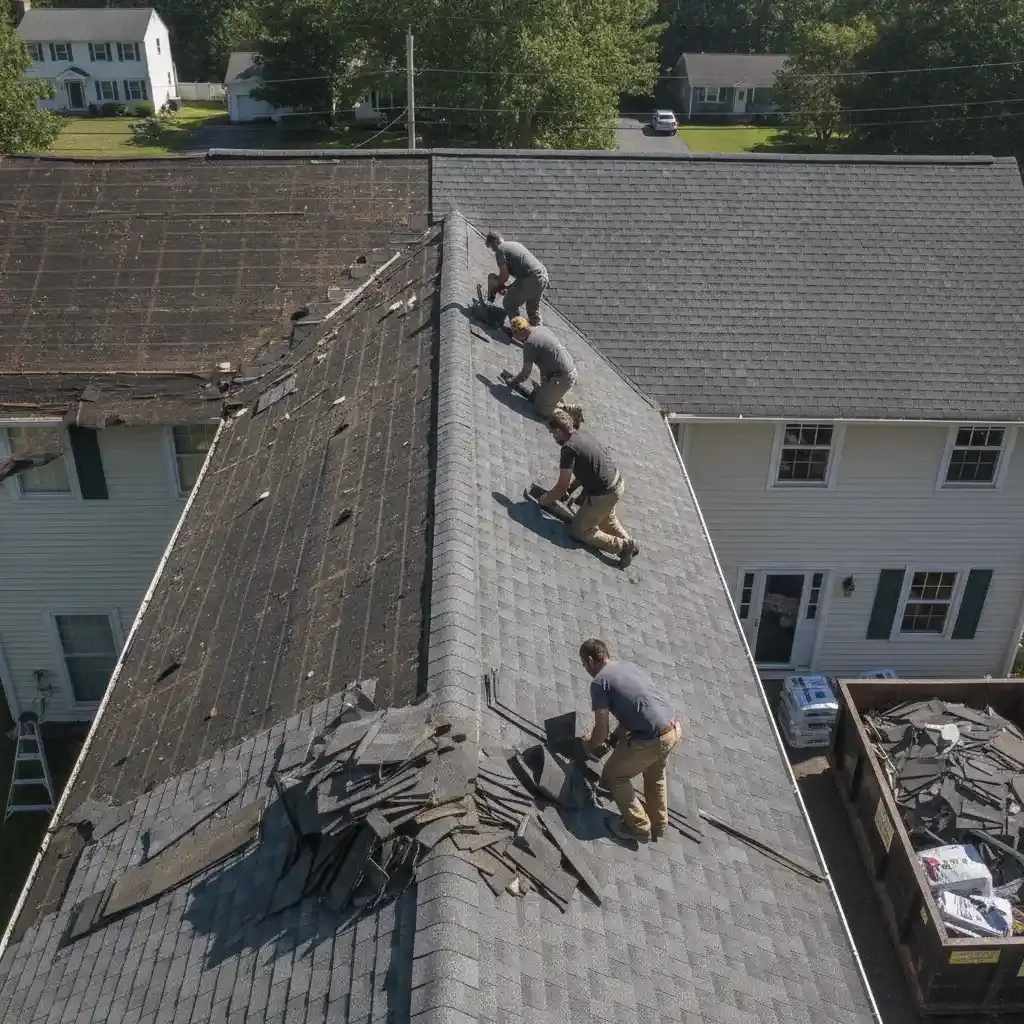
Our crew removes all existing roofing materials down to the decking. Every square foot of decking is inspected; damaged or rotted sections are replaced before any new materials go down. This step is critical — we find hidden deck damage in approximately 40 per
- 05
Ice-and-Water Shield and Underlayment (Installation Day 1–2)
Massachusetts Building Code and manufacturer warranties require ice-and-water shield to extend a minimum of 24 inches inside the interior wall line at all eaves — we always meet or exceed this standard, installing it in valleys and around all penetrations as w
- 06
New Roof Installation and Flashing (Installation Day 1–3)
Shingles, metal panels, or membrane are installed per manufacturer specifications. All flashing at chimneys, skylights, vents, and walls is replaced with new aluminum or copper material — never reused. Ridge ventilation is assessed and upgraded as needed to ad
- 07
Final Inspection and Cleanup (Final Day)
We conduct a full walk-around inspection and provide photographic documentation of the completed installation. All debris is removed and disposed of, and a magnetic roller sweeps the property for nails. Final permit sign-off is arranged where required by your
Roof Replacement Methods and Approaches
Architectural Asphalt Shingle Replacement
The most common method for residential steep-slope roofs throughout Greater Boston. Architectural (dimensional) shingles provide superior wind resistance (rated to 110–130 mph) compared to three-tab shingles, making them particularly appropriate for coastal communities like Quincy, Weymouth, and Lynn where nor’easter wind exposure is highest. Algae-resistant shingles with copper granules are recommended for shaded properties in wooded areas of Milton, Canton, and Needham. Typical project duration: 1 to 3 days.
Standing-Seam Metal Roofing
An increasingly popular choice for steep-slope residential and commercial applications. Standing-seam metal is exceptional at shedding snow — critical for Boston’s winter snowfall loads — and carries a 40-to-50-year service life. It is particularly well-suited for historically styled homes in Brookline and Newton where the aesthetic aligns with the architecture. Metal roofing also eliminates ice-dam risk by allowing snow to slide clear before melt cycles begin. Typical project duration: 3 to 5 days.
Flat Roof Membrane Replacement (TPO/EPDM)
Essential for Greater Boston’s many triple-deckers, row houses, and commercial buildings with flat or low-slope roofs. TPO (Thermoplastic Polyolefin) is preferred for high-UV commercial applications in the Waltham and Newton commercial corridors. EPDM (rubber membrane) remains common for residential flat roofs due to its flexibility in cold temperatures — an important property given Boston’s sub-zero winter days. Typical project duration: 1 to 3 days depending on building size.
Slate and Synthetic Slate Replacement
Many Victorian and Federal-era homes in Brookline, Milton, and older Newton neighborhoods have original slate roofs approaching or exceeding 100 years of age. When natural slate replacement is cost-prohibitive, high-quality synthetic slate (polymer composite) provides period-appropriate appearance with modern performance characteristics, including superior wind resistance and a 50-year rated lifespan. Learn more about our roofing installation options.
Roof Replacement Cost in Greater Boston, MA
Understanding roof replacement costs in Greater Boston requires accounting for factors that differ significantly from national averages. Greater Boston’s high labor costs, permitting requirements, and material delivery logistics to dense urban neighborhoods all influence final pricing.
Typical Cost Ranges
- Architectural Asphalt Shingles (residential): $8,500 – $18,000 for an average 1,500–2,500 sq. ft. home
- Standing-Seam Metal (residential): $18,000 – $40,000 depending on complexity and home size
- Flat Roof EPDM/TPO (residential triple-decker or small commercial): $6,000 – $15,000
- Natural Slate: $30,000 – $80,000+ depending on slate source and roof complexity
- Synthetic Slate: $18,000 – $35,000
Read moreShow less
Key Cost Factors
- Roof size and complexity: Multiple valleys, dormers, and steep pitches common in Boston-area Victorians and Capes add 20–40% to labor costs
- Deck repair: Ice-dam damage requiring deck replacement adds $2–$5 per square foot
- Permit fees: Vary by municipality — Boston, Brookline, and Newton tend to have higher permit fees than outlying communities
- Accessibility: Dense urban lots in Somerville, Malden, or Watertown may require specialty equipment or limited access allowances
- Material choice and grade: Impact-resistant Class 4 shingles recommended for coastal exposure carry a 10–15% material premium
Greater Boston roof replacement prices run approximately 15 to 25 percent above national averages due to regional labor rates and material costs. We provide transparent, itemized quotes with no hidden fees. Request your free cost estimate today.
Neighborhoods and Communities We Serve
Brookline and Newton
These inner-ring suburbs contain some of the oldest and most architecturally complex residential roofing challenges in Greater Boston. Victorian Painted Ladies and large Colonials with multiple roof planes, slate originals, and ornate flashing details require precise, experienced crews. Many properties in Brookline’s Coolidge Corner and Newton’s Chestnut Hill neighborhood are in the 80-to-120-year age range, making full roof system replacement a priority for current owners.
Quincy, Weymouth, and Braintree
South Shore communities along Boston Harbor face the dual challenge of coastal salt-air exposure and significant winter storm track exposure. Postwar ranch and split-level homes built in the 1950s and 1960s are now reaching their second full roofing replacement cycle. Algae-resistant and impact-resistant shingle grades are particularly important in this zone.
Somerville, Malden, and Medford
Dense urban communities characterized by triple-deckers and two-family homes with flat or very low-slope roof sections. EPDM and TPO membrane replacement is in high demand across these neighborhoods. Tight lot lines and street parking require careful project logistics coordination. Learn about our commercial and multi-family roofing services.
Milton and Canton
These Blue Hills corridor communities feature wooded lots that accelerate algae, moss, and lichen growth on north-facing and shaded roof surfaces. Overhanging trees contribute to debris accumulation that traps moisture and shortens shingle life. Algae-resistant shingles and proper attic ventilation upgrades are standard recommendations for these areas.
Roof Maintenance Tips for Greater Boston Homeowners
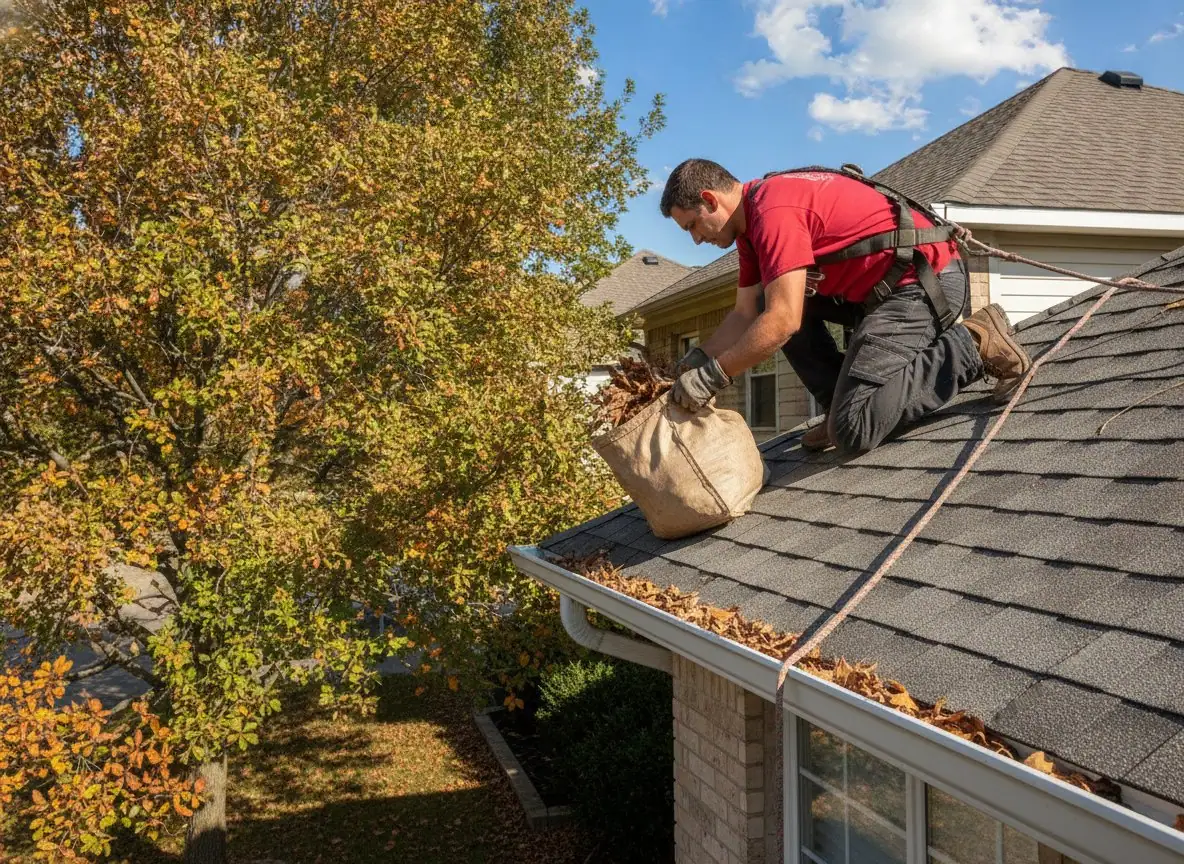
- Clean gutters twice annually: In fall after leaf drop and in spring after winter debris accumulation. Clogged gutters are the number-one contributor to ice-dam formation at Boston eaves.
- Inspect attic ventilation every fall: Proper intake and exhaust ventilation reduces heat buildup at the roof deck that triggers ice dams. Target an attic temperature within 5–10°F of outdoor ambient temperature in winter.
- Remove heavy snow accumulation: Use a roof rake after major snowfall events to remove the first 3–4 feet of snow from eaves — the zone where ice dams form. Do not walk on the roof during or after storms.
- Trim overhanging branches: Especially important for wooded properties in Milton, Canton, and Needham where limb falls and debris accumulation are common year-round hazards.
- Schedule annual professional inspections: A professional roof inspection each fall before nor’easter season identifies developing issues before they become full replacements.
- Address moss and algae promptly: Apply zinc strips at the ridge or use approved biocide treatments — do not pressure wash, as this strips granules and voids shingle warranties.
- Check flashing at all penetrations: Boston’s brick chimneys are a common flashing failure point. Inspect sealant and metal condition every 3–5 years.
- Document your roof’s age and maintenance history: This is critical for insurance claims after nor’easter events and for accurate replacement planning.
Why Choose Blue Hills Roofing Solutions for Your Greater Boston Roof Replacement
Blue Hills Roofing Solutions is a Greater Boston roofing company built specifically for Greater Boston conditions. Our project managers and installation crews understand the ice-dam dynamics of triple-decker flat roofs in Somerville, the slate complexities of Brookline Victorians, the coastal salt-air degradation that shortens roofing lifespans in Quincy and Weymouth, and the permitting landscape across all 19 communities we serve — from Milton and Canton along the Blue Hills corridor to Lynn and Malden on the North Shore.
We do not subcontract our installations to unknown crews. Every project is completed by trained Blue Hills Roofing Solutions employees held to consistent quality standards. We pull all required permits, conduct all required inspections, and document every project with pre- and post-installation photography for your records and insurance purposes.
Read moreShow less
We offer transparent, itemized pricing with no surprise add-ons. We work with your homeowner’s insurance carrier on storm-damage claims and provide all required documentation to support your claim. Whether you need emergency roof repair, routine roof maintenance, or a full roof replacement, Blue Hills Roofing Solutions is your Greater Boston roofing partner.
FAQ
Frequently Asked Questions: Roof Replacement in Greater Boston
How much does roof replacement cost in Greater Boston, MA?
For a typical Greater Boston single-family home with an asphalt shingle roof, expect a range of $8,500 to $18,000. Larger or more architecturally complex homes, steep pitches, multi-plane designs common in Newton and Brookline, or premium materials like metal or synthetic slate will increase costs. Greater Boston pricing runs 15 to 25 percent above national averages due to regional labor rates, permit costs, and material logistics. We provide free, detailed written estimates so you know exactly what you are paying for.
How long does a roof replacement take in Greater Boston?
Most residential asphalt shingle replacements are completed in one to three days of active work. Larger homes, complex roof designs, or premium material installations (metal, slate, or synthetic slate) may require three to five days. We schedule around Greater Boston’s weather patterns and keep you informed of any adjustments due to the region’s unpredictable nor’easter season.
Do I need a permit for roof replacement in Boston or surrounding towns?
Yes. Full roof replacements require building permits in virtually all Greater Boston municipalities. This is required by Massachusetts Building Code 780 CMR. Blue Hills Roofing Solutions handles all permitting on your behalf in every community we serve, from Boston and Brookline to Norwood and Waltham. Never hire a contractor who suggests skipping permits — it creates serious liability for the homeowner.
What is the best roofing material for Greater Boston’s climate?
For most residential steep-slope applications, high-grade architectural asphalt shingles with algae resistance and Class 4 impact resistance offer the best value-to-performance ratio for Greater Boston’s combination of nor’easters, freeze-thaw cycles, and coastal humidity. For coastal-facing properties in Quincy, Weymouth, or Lynn, impact-resistant shingles are strongly recommended. For flat or low-slope roofs common in Somerville, Malden, and Medford triple-deckers, TPO or EPDM membrane replacement is the appropriate solution.
How do I know if my roof needs replacement or just repair?
A professional inspection is the only reliable way to make this determination. Generally, if damage affects more than 30 percent of the roof surface, if the roof is more than 20 years old, if there is evidence of decking damage from ice dams, or if repairs have been made more than twice in recent years, replacement is typically more cost-effective than continued repair. Schedule a professional inspection to get a clear, honest answer.
Does Blue Hills Roofing Solutions help with insurance claims for storm damage?
Yes. We have extensive experience working with homeowners and their insurance carriers on storm-damage claims following nor’easters, hail events, and high-wind damage throughout Greater Boston. We provide detailed written assessments, photographs, and documentation in the format insurance adjusters require. The March 2018 nor’easter series that impacted Braintree, Randolph, Canton, and surrounding communities generated significant insurance claim work — we understand this process thoroughly.
How long will my new roof last in Greater Boston?
High-grade architectural asphalt shingles properly installed on a Greater Boston home with adequate attic ventilation can be expected to last 22 to 30 years. Standing-seam metal roofing carries a 40-to-50-year realistic lifespan. TPO and EPDM flat roof membranes typically last 15 to 25 years depending on maintenance. Note that coastal properties in communities like Quincy and Weymouth may see 15 to 20 percent reductions in these lifespans due to salt-air exposure.
Can you replace my roof in winter in Greater Boston?
Yes, with important qualifications. Asphalt shingles require temperatures above approximately 40°F for proper adhesive sealing; we monitor forecasts carefully and schedule accordingly. Emergency situations — active leaks, storm damage — are addressed year-round with appropriate weatherization and temporary protective measures until conditions allow full installation. We do not force installations in conditions that compromise quality or safety.
Get Your Free Roof Replacement Estimate in Greater Boston Today
Your Greater Boston home deserves a roof built to handle everything the region’s climate delivers — from the record nor’easters of 2015 and 2018 to the relentless freeze-thaw cycles that define every Massachusetts winter. Blue Hills Roofing Solutions provides honest assessments, transparent pricing, expert installation, and thorough documentation for every project we complete across our 19 Greater Boston service communities.
Do not wait for an active leak to address a failing roof. The cost of water damage to insulation, framing, and interior finishes almost always exceeds the cost of timely replacement. Reach out today:
- Call or Text: (617) 712-2287
- Request a Free Estimate Online
- Schedule a Roof Inspection
Read moreShow less
Blue Hills Roofing Solutions — Greater Boston’s roof replacement specialists, serving Milton, Quincy, Boston, Braintree, Randolph, Dedham, Canton, Brookline, Weymouth, Needham, Norwood, Medford, Newton, Waltham, Wellesley, Watertown, Malden, Somerville, and Lynn.
Get in touch
Find roofing help near you
Request a free estimate online or give us a call — our team will follow up quickly.
- Call us(617) 712-2287
- Visit2 Granite Ave Ste 512, Milton, MA 02186
- HoursMon-Sun 7am-7pm